Rosemary-Infused Water with Honey and Lemon – Made by Cold Infusion
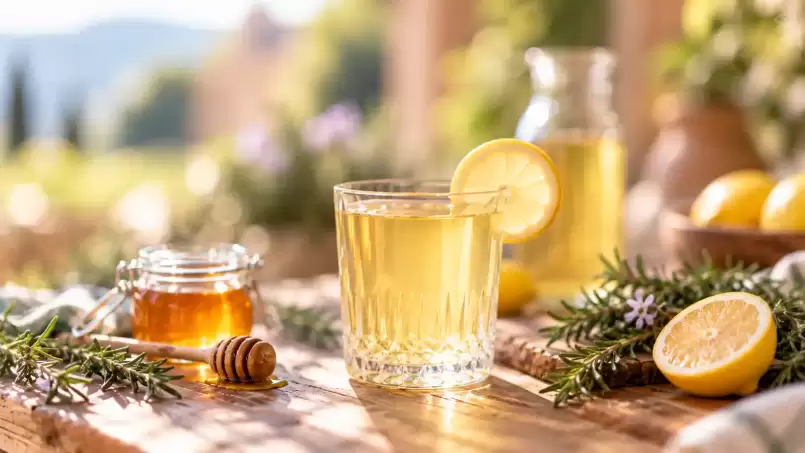
A fragrant, slightly tart beverage made by macerating rosemary and undergoing a short fermentation process.
Rosemary-infused water with honey and lemon, prepared through cold maceration, is an artisanal beverage with a sweet-and-sour taste and a herbal aroma. All the ingredients are left together at room temperature for 1–3 days, during which time maceration and fermentation occur simultaneously. Discover the preparation method, the properties of the ingredients, and important precautions.
Servings: 9 servings
One serving is approximately 200 ml of the beverage, served cold, either straight or diluted with water. The quantities listed yield approximately 9 servings.
Ingredients
Materials
- - a 2.5–3-liter glass jar, thoroughly cleaned and sanitized
- - a fermentation lid with a vent to release gases
- - a spoon or spatula for stirring
- - fine-mesh strainer or clean food-grade cheesecloth
- - citrus juicer
- - kitchen scale and precision scale for yeast
- - funnel and clean food-grade containers for storage
Preparation
- Preparing the Ingredients
Wash the rosemary and lemons thoroughly. Gently crush the rosemary leaves to help release their aroma. Squeeze the lemons and have the honey, water, and nutritional yeast ready. - Mixing the Ingredients
Place the rosemary in a clean glass jar. Add the water, honey, lemon juice, and yeast. Stir well until the honey dissolves and the ingredients are evenly distributed. - Cold Maceration and Fermentation
Cover the container with a fermentation lid equipped with a valve to release gases. Keep the rosemary submerged in the liquid. The traditional process involves storing the mixture at room temperature (20–22°C) for 1–3 days, without boiling. During this time, maceration and fermentation occur simultaneously. The indicated duration is a guideline, not a guarantee of safety. - Filtering and Storage
At the end of the process, strain the liquid through a fine sieve to remove the rosemary and any sediment. Transfer it to a clean food-safe container and place it in the refrigerator immediately. Do not seal it under pressure if fermentation continues.
Storage 🧊
- Use clean food-grade containers without airtight lids if fermentation continues.
- Do not leave hermetically sealed bottles at room temperature; the gases produced can cause overpressure.
- If mold, a viscous consistency, an unusual odor, or other signs of spoilage appear, discard the mixture.
- Normal appearance, smell, and taste do not guarantee microbiological safety.
- Refrigeration slows fermentation but does not eliminate any potentially dangerous microorganisms.
- A safe shelf life cannot be established for this unvalidated formula.
Administration
- First time: 50–100 ml, to check for digestive tolerance.
- Usual serving: 100–200 ml, occasionally, as a meal accompaniment.
- Best consumed with or after a meal, especially if you have a sensitive stomach.
- May be diluted with still water if the taste is too intense or acidic.
- Daily consumption is not recommended for therapeutic purposes, and there is no established medicinal dose for this beverage.
- Do not consume the product if fermentation could not be carried out under safe microbiological conditions.
Observations
Both methods use the same ingredients, but the extraction method influences the flavor, the extracted compounds, and the characteristics of the beverage.
1. Extraction of Compounds from Rosemary
- Cold: Extraction occurs gradually during maceration.
- Hot: The high temperature promotes faster extraction of many water-soluble compounds.
2. The beverage’s flavor
- Cold: a fresher, herbaceous flavor with distinct citrus notes, though it may become intense or bitter after prolonged maceration.
- Hot: a more pronounced rosemary aroma right from the start of steeping, sometimes slightly bitter.
3. Vitamin C and temperature-sensitive compounds
- Cold: the absence of heating limits the thermal degradation of certain sensitive compounds.
- Hot: Heating can reduce certain compounds, depending on temperature and duration.
- The difference is smaller if lemon juice is added after the infusion has cooled.
4. Microbiological Safety
- Cold method: The ingredients are not heat-treated, so microorganisms present initially can survive and multiply.
- Hot method: Infusion reduces part of the microbial load, but does not guarantee the safety of subsequent fermentation.
5. Preparation Time
- Cold method: maceration and fermentation occur simultaneously for 1–3 days at room temperature.
- Hot method: the rosemary is infused for approximately 10–15 minutes, then the liquid is cooled and fermentation begins.
6. Fermentation
- Cold method: The rosemary remains in the mixture throughout maceration and fermentation.
- Hot method: The rosemary is initially extracted through infusion and can be removed before fermentation.
- In both methods, yeast can convert sugars into carbon dioxide and alcohol.
7. Which method is better?
- For a fresh herbal flavor and preparation without boiling, the cold method may be preferred.
- For rapid extraction of compounds from rosemary, the hot method may be more efficient.
- There is no evidence that one method offers superior clinical benefits over the other.
⚠️ Important Caution
The 1–3-day timeframe is a traditional practice, not a microbiologically validated fermentation process. Honey and lemon alone do not guarantee the safety of the beverage, and the appearance of bubbles does not confirm that the product is safe for consumption.
Effects and benefits
- 💧 Hydration – helps meet your daily fluid intake.
- 🌿 Digestive comfort – rosemary has traditionally been used for mild dyspepsia.
- 🍃 Relief from mild digestive spasms – an effect traditionally attributed to preparations made from rosemary leaves.
- 🛡️ Source of plant-based antioxidants – rosemary contains phenolic compounds with antioxidant activity demonstrated in laboratory studies.
- 🧪 Source of rosmarinic acid – a natural compound studied for its biological properties.
- 🌱 Variety of phytonutrients – adds compounds extracted from aromatic leaves to the diet.
- 🍋 Modest source of vitamin C – derived from lemon juice, in varying amounts.
- 🧬 Cellular antioxidant protection – vitamin C helps protect cells against oxidative stress.
- 🦴 Collagen formation – vitamin C contributes to normal collagen synthesis, although the amount provided per serving is low.
- 🩸 Iron absorption – vitamin C may promote the absorption of iron from plant-based foods.
- 🍯 Quick energy boost – honey provides easily digestible carbohydrates.
- 🌼 Natural flavor – rosemary and lemon provide flavor without the need for synthetic flavorings.
- 👃 Pleasant aromatic experience – retains fresh herbal notes and a citrusy aroma.
- 👅 Stimulates salivation – the slightly tart taste can temporarily increase saliva production.
- 🥤 An alternative to commercial soft drinks – can be prepared without artificial colors or flavors.
- 🌞 Improves the palatability of water – the flavor can encourage fluid intake.
- 🫧 Naturally effervescent – fermentation with yeast can produce carbon dioxide.
- ☕ Caffeine-free – a flavorful alternative to some stimulant beverages.
- 🥛 Lactose-free – can be consumed by people with lactose intolerance, provided there are no other contraindications.
- ⚖️ No significant fat content – the beverage consists mainly of water and carbohydrates.
- 🌡️ Prepared without heating – allows for a flavor profile different from that of a hot infusion.
- 🍹 Versatile serving options – can be diluted and occasionally incorporated into a varied diet.
Side effects
- 🫧 Bloating and intestinal gas – carbon dioxide can cause digestive discomfort.
- 🔥 Heartburn or acid reflux – the acidity of lemons can worsen symptoms.
- 🤢 Nausea or abdominal cramps – possible in cases of digestive intolerance.
- 🚽 Loose stools or diarrhea – may occur in sensitive individuals.
- 🌿 Allergic reactions—possible to rosemary, citrus fruits, honey, or yeast.
- 🦷 Tooth sensitivity—frequent consumption of acidic beverages can contribute to enamel erosion.
- 🍯 Increased blood sugar levels – the beverage may contain residual sugars from honey.
- 🍷 Alcohol formation – fermentation with yeast may produce varying amounts of ethanol.
- 🦠 Microbiological contamination – uncontrolled fermentation may promote the growth of undesirable microorganisms.
Contraindications
- Pregnancy and breastfeeding – medicinal preparations containing rosemary are not recommended; fermented beverages pose additional risks.
- Children and adolescents under 12 years of age – consumption for medicinal purposes is not recommended.
- Allergy to rosemary, lemon, honey, or yeast – consumption is contraindicated.
- Gallstones, biliary obstructions, or gallbladder inflammation – avoid without medical advice.
- Liver disease—avoid without medical advice.
- Severely compromised immunity—avoid artisanal and unpasteurized fermented beverages.
- Strict abstinence from alcohol—fermentation can produce ethanol even if the beverage does not taste alcoholic.
- Poorly controlled diabetes – residual sugars may affect blood sugar levels.
- Severe gastroesophageal reflux, symptomatic gastritis, or active ulcers – acidity may worsen symptoms.
- People with digestive sensitivity to fermented beverages—consumption may increase bloating and discomfort.
Cold macerationis a method of extracting soluble compounds from plants without heating the liquid. In this recipe, maceration takes place at room temperature, simultaneously with fermentation, over the course of 1–3 days.
What substances does rosemary contain?
Rosemary contains rosmarinic acid, other phenolic compounds, and volatile aromatic substances, including 1,8-cineole. The amounts extracted depend on the raw material, water temperature, and maceration duration.
The Role of Honey in Fermentation
Honey provides the sugars used by yeast to produce carbon dioxide and alcohol. After dilution in water, honey no longer offers the microbiological protection specific to the concentrated product.
The Role of Lemon
Lemon juice adds acidity and flavor and provides modest amounts of vitamin C. Acidity can influence the growth of microorganisms, but adding lemon does not guarantee the safety of the fermentation process.
Simultaneous maceration and fermentation
Unlike the hot infusion method, in this method rosemary, water, honey, lemon, and yeast are combined from the start. Thus, the extraction of aromatic compounds and fermentation take place in the same container.
Alcoholic fermentation versus lactic fermentation
Baker’s yeast promotes alcoholic fermentation, producing carbon dioxide and ethanol. Lactic fermentation involves other microorganisms and cannot be assumed solely based on the presence of bubbles.
Safety of preparation without boiling
Preparation without heat treatment preserves the aromatic characteristics of the ingredients, as well as the microorganisms initially present. Fermentation at room temperature requires a validated method and acidity control. This artisanal formula has not undergone microbiological validation.
Therapeutic Value
Rosemary has traditional uses for mild digestive disorders. These uses do not demonstrate the efficacy of the fermented beverage, for which specific clinical studies are lacking. The preparation should not be considered a medical treatment.
FAQ 💡❓
Is cold maceration more effective than a hot rosemary infusion?
➡️ Not necessarily. Hot water extracts many phenolic compounds more quickly, while cold maceration yields a different flavor profile. The effectiveness depends on the specific substance you’re targeting.
Why might rosemary-infused water taste different each time?
➡️ Temperature, fermentation time, sugar content, yeast activity, and the composition ofthe rosemary all influence thefinal taste and aroma.
Does raw honey make the drink healthier or safer?
➡️ There is no evidence that using raw honey guarantees additional benefits after fermentation. When diluted in water, honey loses the microbiological protection provided by its high sugar concentration.
Why doesn’t fermentation with yeast automatically mean a probiotic beverage?
➡️ Yeast primarily produces alcohol and carbon dioxide. A probiotic product must contain well-characterized microorganisms with proven health benefits.
Can alcohol form even if we use very little yeast?
➡️ Yes. The amount of alcohol depends on the sugars, temperature, time, and yeast activity. A small amount of yeast does not guarantee the absence of alcohol.
Why doesn’t lemon guarantee safe fermentation?
➡️ The final acidity depends on the amount of juice and the proportions of the ingredients. A sour taste does not prove that the beverage is microbiologically safe.
What happens to rosemary if it remains in water for 1–3 days?
➡️ The soluble compounds gradually transfer into the liquid, intensifying the aroma. Prolonged maceration can result in a more bitter and astringent taste.
Why is the rosemary left in the liquid throughout the fermentation process?
➡️ So that the extraction of aromatics continues alongside fermentation. However, fresh herbs can introduce unwanted microorganisms, so this method requires caution.
How can we tell if the bubbles indicate successful fermentation?
➡️ Bubbles show that gas is being produced, but they do not confirm the safety of the beverage. Safe fermentation requires a controlled and verified process.
Does fermentation completely remove the sugar from the honey?
➡️ Not necessarily. The amount of residual sugars depends on the duration and intensity offermentation. The drink cannot be considered sugar-free without an analysis.
Is this drink suitable for a detox regimen?
➡️ There is no evidence that it eliminates toxins or stimulates the body’s detoxification process. The liver and kidneys normally perform these functions.
Comments