Burdock and Ginger Compress for Wrist and Knee Pain
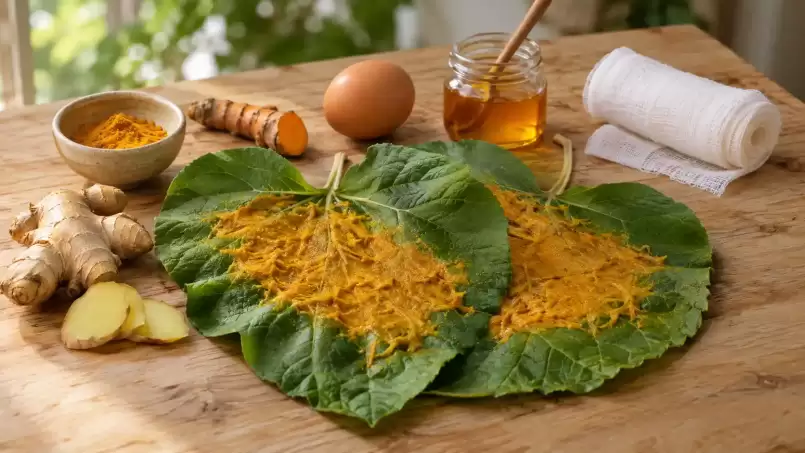
A poultice made from burdock leaves and grated ginger, traditionally used for sore knees
The burdock, ginger, and turmeric compress is a poultice traditionally used to provide local relief when the knee is slightly sore or stiff. Mix fresh ginger, turmeric, an egg, and honey into a paste, then spread it on the leaves. This recipe makes two compresses, one for each knee. White cabbage leaves can be used instead of burdock.
Servings: 2 servings
One serving consists of a compress for one knee, made from two burdock or cabbage leaves and half the mixture of ginger, turmeric, egg, and honey.
Ingredients
Materials
- - Knife
- - Food processor or fine grater and bowl
- - Teaspoon
- - Clean cheesecloth
Preparation
- Prepare the leaves. Wash the four burdock or cabbage leaves on both sides and pat them dry with a clean towel. If the central vein is too thick and the leaf is hard to fold, thin it out with a knife, being careful not to pierce the leaf.
- Place the leaves on the foil. Spread two pieces of plastic wrap on the countertop—one for each compress. Place two leaves on each piece, side by side, with the edges slightly overlapping in the middle. Let the plastic wrap extend beyond the leaves on all sides to catch any paste that might drip and to give you something to grip when you pick up the compress.
- Prepare the paste. Place the 10 slices of ginger, the raw egg, the 3 level teaspoons of turmeric, and the teaspoon of honey in a food processor. Blend until the ginger is finely chopped and the paste is smooth. If the blades don’t catch the slices, finely grate the ginger and mix it in a bowl with the egg, turmeric, and honey.
- Divide the paste between the two compresses. Place half of the paste on each pair of leaves. Spread it with a teaspoon from the center toward the edges, leaving about two fingers’ width free all around. This allows the paste to spread out when you place the compress on your knee.
- Place the compress on your knee. Support your leg. Grab the foil by two opposite edges and lift the leaves and paste along with it. Turn the compress so that the side with the paste faces the healthy skin, and place it on your knee. Starting from the skin and working outward, the order is paste, leaves, foil.
- Secure the compress with a gauze bandage. Gently wrap the bandage over the outer plastic wrap, just enough to hold the compress in place. Leave the edges of the plastic wrap loose and avoid wrapping them over each other around the knee.
Storage 🧊
Unused leaves. Burdock leaves will keep for a few days in the refrigerator, in a bag or wrapped in a slightly damp towel. White cabbage leaves will keep longer, usually one to two weeks, in the vegetable drawer.
Leftover ginger and turmeric. Store ginger in the refrigerator or freezer, and turmeric in a tightly sealed jar, away from light and moisture.
Administration
Application. Prepare the compress just before use and apply it at room temperature to a clean, dry knee with intact skin. Keep your leg elevated and leave the compress on for 20–30 minutes. If you feel a strong burning sensation, remove it immediately.
How often. Once a day, during periods when your knees hurt or feel stiff. If the skin remains red or irritated after an application, take a break until it has completely calmed down.
After application. Unwrap the bandage, lift the plastic wrap and the leaves together, then wash the area with lukewarm water and soap. Turmeric may temporarily stain the skin yellow, and a cotton pad with a little vegetable oil helps remove the stain.
Don’t leave it on overnight. Don’t fall asleep with the compress on your knee, because your skin would be in contact with the ginger for too long.
Observations
Ginger and sensitive skin. Fresh ginger can cause a strong warming sensation on the skin. If you have sensitive skin, use less ginger or shorten the application time.
Protect whatever the compress touches. Turmeric stains fabrics. Place an old towel under your knee while you’re wearing the compress.
Caution. The compress is a traditional remedy for local relief and is not a substitute for medical advice. If pain comes on suddenly, persists, your knee swells or becomes hot, or you develop a fever, see a doctor.
Effects and benefits
- 🔥 Pleasant localized warmth. Fresh ginger provides a warming sensation, which is especially appreciated when your knees are cold and stiff.
- 🦵 Relief for aching knees. The compress is traditionally used for mild joint pain and stiffness.
- 🌿 Gingerols from ginger. Ginger contains compounds known for their anti-inflammatory properties.
- 🟡 Curcumin from turmeric. It is a compound with antioxidant and anti-inflammatory effects.
- 🍃 Burdock leaves. They are traditionally used in joint compresses and contain plant compounds with antioxidant effects.
- 🥬 White cabbage, an alternative to burdock. It is traditionally used in compresses for swollen or tired joints.
- 🍯 Honey for the paste and skin. Honey keeps the paste smooth and adhesive and gently moisturizes the skin.
Side effects
- Redness or a strong sensation of heat, especially on sensitive skin.
- A stinging or itching sensation at the application site.
- Temporary yellow discoloration of the skin, nails, and fabrics due to turmeric.
Contraindications
- Allergy to burdock (or other plants in the daisy family), ginger, turmeric, eggs, or honey. Do not use the compress.
- Broken skin, wounds, eczema, irritation, or infections in the knee area. Avoid application.
- A swollen, red, and hot knee, or a knee that has recently been hit or sprained. Seek medical evaluation first.
- Knee pain accompanied by a fever. See a doctor; do not treat with a compress.
- Previous skin reactions to ginger. Perform a sensitivity test first or avoid this remedy.
Fresh ginger, not powdered. Fresh ginger has a higher gingerol content, and its paste spreads easily on the leaf. Ginger powder is spicier and drier, so it’s easier to use too much.
The leaf, not the root. In folk medicine, burdock root is used primarily in teas and decoctions, while the leaves are used in external compresses, such as this one.
FAQ 💡❓
Why do you put a raw egg in a compress?
➡️ The egg binds the ginger and turmeric into a creamy paste that stays on the leaf and doesn’t run off. Because it’s raw, the paste is prepared right before use and cannot be stored.
Burdock or cabbage: which leaves work best?
➡️ Choose based on the season. Burdock has large, sturdy leaves, but it’s only available in the summer. White cabbage is available year-round, and its leaves are easier to shape around your knee if you gently crush the midrib.
Can I use ginger powder instead of fresh ginger?
➡️ You can, but the powder is spicier and may irritate the skin more easily. Use a smaller amount than you would of fresh ginger, and do a sensitivity test first.
Can I use the same paste on other joints?
➡️ Yes, on any joint with intact skin, such as the elbow or ankle. The skin is thinner on small joints, so use less paste and monitor your skin’s reaction.
Can I warm the compress or place a hot water bottle on top of it?
➡️ This is not recommended. The egg would coagulate in the paste, and the extra heat increases the risk of irritation. The ginger already provides a warming sensation.
Can I secure the compress with an elastic bandage instead of a gauze bandage?
➡️ Gauze is more suitable. A tight elastic bandage presses the paste against the skinand may increase irritation or constrict the knee.
How do I remove yellow turmeric stains from my skin and clothes?
➡️ To remove it from your skin, wash with lukewarm water and soap, then wipe with a cotton pad dampened with a little vegetable oil. To remove it from clothing, rinse as quickly as possible with cold water, wash with detergent, and any remaining stains usually fade in sunlight.
Is it normal for my skin to be red after using a compress?
➡️ A slight redness immediately after removing the compress may be caused by the ginger. If it persists or is accompanied by itching, swelling, or blisters, stop using the remedy.
Comments