Burdock
Burdock – Benefits, Properties, and Contraindications for the Leaves and Root
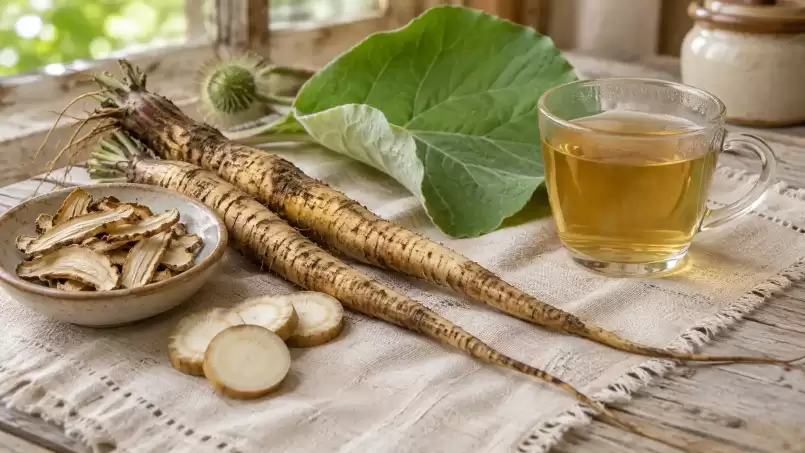
Burdock leaves have remained part of traditional folk remedies for knee ailments, and the root is traditionally used to stimulate appetite, treat minor urinary problems, and address seborrheic skin conditions. Find out what we know about burdock tea, the benefits of compresses and massage creams, how to prepare the root, and what precautions to take before use.
What is burdock, and which parts of the plant are used?
The greater burdock (Arctium lappa), sometimes called lipan or brustan, is a plant native to temperate Eurasia and is also found in Romania. It has broad leaves with a fuzzy underside, purple flowers, and burrs that cling to clothing. The fresh leaves were used in traditional folk remedies as compresses. The root, which is long and brown on the outside, is used in teas, tinctures, and some creams. In cooking, the young root has a mild, slightly sweet taste, with a more pronounced earthy aroma in mature specimens.
Nutritional values of burdock root per 100 g
One hundred grams of raw burdock root provides approximately 72 kcal and 3.3 g of fiber. The USDA values refer to the edible part of the root, used as a vegetable. Much smaller amounts of dried root are used for tea, and the values below do not reflect the composition of a cup of tea.
- Energy – 72 kcal
- Water – 80.09 g
- Total carbohydrates – 17.34 g
- Dietary fiber – 3.30 g
- Sugars – 2.90 g
- Protein – 1.53 g
- Total fat – 0.15 g
- Saturated fat – 0.025 g
- Potassium – 308 mg
- Phosphorus – 51 mg
- Calcium – 41 mg
- Magnesium – 38 mg
- Sodium – 5 mg
- Iron – 0.80 mg
- Manganese – 0.23 mg
- Vitamin C – 1.6 mg
- Vitamin B6 – 0.24 mg
- Folate (vitamin B9) – 23 µg
- Vitamin E – 0.38 mg
Health Benefits and Properties of Burdock
Burdock is sought after for leaf compresses, scalp care, and root tea, and when the root is consumed as a vegetable, the most easily quantifiable benefit is its fiber and nutrient content.
Knees, Back, and Neck
- Leaves for sore knees and joints. In folk remedies, the fresh leaf is crushed until soft and applied as a compress. This is a traditional external use. There is insufficient clinical evidence to determine whether the leaf reduces pain or swelling.
- Relief from back and neck massage. Some creams and balms contain burdock root extract and are used to massage tense muscles. Gentle massage may provide temporary relief. The extent to which the extract itself contributes to relieving back or neck pain remains unclear.
- Burdock root tea, studied for knee osteoarthritis. In small studies of people with knee osteoarthritis, changes were reported in certain markers of inflammation in the blood and in measures of pain and mobility. Participants also followed the standard of care specified in the study. Preliminary results need to be confirmed before the tea can be recommended for this condition.
Scalp, skin, appetite, and urinary tract
- Scalp and hair care. Burdock oil and rinses made from a root decoction are part of traditional hair care. The oil is used topically, usually before shampooing. There is insufficient evidence to support its use for stimulating hair growth.
- Traditional use for seborrheic skin. The European Medicines Agency (EMA) notes the oral use of root preparations for seborrheic conditions, which may include oily patches and flaking. This use is based on long-standing practice. If redness, itching, and flaking recur, a dermatologist can determine the cause.
- Increased urine output. The root is traditionally used to promote urination in cases of minor urinary discomfort. It serves as an adjunct (a supplement to standard care). If you suspect a urinary tract infection, you need an evaluation and treatment appropriate to the cause.
- Temporary loss of appetite. Tea and other preparations made from the root are traditionally used when appetite is temporarily reduced. Long-term use is documented in the EMA monograph. A persistent lack of appetite or unexplained weight loss warrants evaluation.
Fiber, minerals, and compounds studied in burdock root
- Fiber intake for digestion. The whole root, eaten as a vegetable, contributes to dietary fiber intake. Dietary fiber helps maintain regular bowel movements. If you typically eat little fiber, introduce the root gradually.
- Inulin for gut bacteria. The root contains inulin (a type of fiber that certain gut bacteria use as food). This fermentation process explains why the root is being studied for its prebiotic potential. It may also cause gas or bloating in sensitive individuals.
- A source of potassium, magnesium, and vitamin B6. When you eat the root, you add these nutrients to a varied diet. Potassium and magnesium contribute to the normal functioning of muscles and nerves. Vitamin B6 helps the body utilize nutrients from food.
- Research on antioxidant activity. The root contains plant compounds such as caffeic acid derivatives. Researchers studied the extracts in the laboratory and also analyzed several indicators of oxidative stress (the imbalance between reactive compounds and the body’s defense mechanisms) in people who drank the tea. These results do not establish whether burdock prevents any disease.
Contraindications and Side Effects of Burdock
Burdock should be avoided in cases of a known allergy to the plant or its family, and medicinal preparations made from the root are not recommended during pregnancy, while breastfeeding, or for individuals under 18 years of age.
- Allergy to Asteraceae. Burdock belongs to the Asteraceae family, along with chamomile and ragweed. A severe allergic reaction has been reported after consuming boiled burdock root. If you experience difficulty breathing or swelling of the tongue or throat, call 112.
- Pregnancy and breastfeeding. The safety of medicinal preparations made from the root has not been sufficiently documented during these periods.
- Children and adolescents. The EMA does not recommend oral medicinal use of the root in individuals under 18 years of age due to a lack of sufficient data.
- Diuretics and other medications. The EMA advises against combining burdock root with diuretics when it is used to treat urinary problems. If you are undergoing treatment, check with your doctor or pharmacist to ensure the chosen product is appropriate for you.
- Contact dermatitis. Burdock compresses may cause a skin reaction characterized by redness, itching, or a burning sensation. Remove the compress if such symptoms appear, and avoid applying it to wounds or already irritated skin.
- Gas and bloating. These may occur after consuming the root, especially if you’re sensitive to inulin or eat a large amount at once.
- When to See a Doctor. Seek prompt medical evaluation if your knee suddenly becomes red, warm, and swollen; if you develop a fever, a burning sensation, or blood in your urine; or if back or neck pain is accompanied by weakness in an arm or leg.
How to Administer and Use Burdock
The fresh leaf is used primarily externally, in compresses, while the root is used in both oral preparations and products for the skin and scalp.
- Tea or infusion. Pour boiling water over the dried, chopped root, let it steep covered, and then strain. Follow the instructions on the package.
- Decoction. Boil the root in water over low heat, then strain. Check whether the product is intended for oral or external use.
- Tincture. This is an extract from the root made with water and alcohol. The concentration and dilution instructions vary by product.
- Cold macerate. The dried root is left to steep in cold water. In some folk recipes, the liquid obtained this way is combined with a separate infusion.
- Powder or extract. The powder is obtained by grinding the dried root, and extracts are available in liquid form or in capsules. Take as directed on the label.
- Compress or poultice. The fresh leaf, washed and lightly crushed, is placed in gauze and applied to intact skin.
- Cream or balm. Topical products are applied in a thin layer with a gentle massage, as directed on the label.
- Cosmetic oil. The root extract can be incorporated into a vegetable oil for the scalp or hair. Apply and remove according to the product instructions.
- Cooked root. Choose a root sold as a food. Wash it thoroughly and add it to soups, stews, or sautéed side dishes.
Natural Burdock Remedies from Traditional Medicine
Burdock leaves, root, and extracts are used in various preparations, ranging from a traditional compress for the knees to scalp treatments and root teas.
- Sore knee —a traditional compress made with fresh leaves, lightly crushed and wrapped in clean gauze.
- Tense back —gently massage the lower back with a cream containing burdock root extract.
- Tense neck and shoulders —burdock balm gently massaged into the muscles.
- Dry scalp – cosmetic oil with burdock root, applied to clean skin before washing.
- Hair care —rinse with a cooled and well-strained decoction, a traditional practice for external use.
- Minor urinary discomfort – tea made from chopped root, traditionally used as an adjunct.
- Temporary loss of appetite – root infusion. Dosed powder is another oral form described by the EMA.
- Seborrheic skin conditions —oral root tincture, traditionally used in adults.
- Traditional care for acne-prone skin – the phytotherapy literature mentions external applications of the root. For persistent acne, the appropriate treatment should be determined in consultation with a dermatologist.
- Joint massage after exercise —a cream for external use, applied to intact skin around the joint.
- Herbal teas known as “depurative” – blends in which the root is combined with dandelion and other herbs. The name comes from tradition.
- An old remedy for the liver —a macerate of the root combined with an infusion—has been documented in Vâlcea as a local practice. For liver diseases, this does not replace medical treatment.
Frequently Asked Questions About Burdock
When choosing a preparation, consider the part of the plant, the intended use, and the recommendations on the label.
What should be applied to the knee—the burdock leaf or root?
In a traditional compress, use a fresh leaf, lightly crushed and placed in gauze. The root may be present as an extract in a massage cream.
Should burdock tea be boiled or steeped?
It can be prepared both ways, depending on the product. For an infusion, pour boiling water over the root, and for a decoction, boil the root in water.
How long can you drink burdock tea?
Follow the product instructions. The EMA recommends consulting a healthcare professional if loss of appetite or minor urinary discomfort persists beyond two weeks of use.
Does burdock cream help with cervical spondylosis?
The cream can be used for a gentle massage of the neck and shoulders. The effect of burdock extract on pain associated with cervical spondylosis has not been sufficiently demonstrated.
Is burdock oil applied to the scalp or along the length of the hair?
It depends on the product. An oil intended for the scalp is applied to the hair roots, usually before shampooing, while a cosmetic oil for the hair strands is applied to the lengths according to the label.
Can burdock tincture be used during pregnancy?
Medicinal preparations made from the root, including tinctures, are not recommended during pregnancy and breastfeeding. There is insufficient data on their safety during these periods.
Did you know...? 21 surprising facts about burdock
Burdock has made its way from village remedies to the kitchen, into old pharmacy books, and even into the history of inventions.
- 🧷 Burdock burrs inspired the Velcro fastener. Swiss engineer George de Mestral studied how they got caught in a dog’s fur and adapted the mechanism for textiles.
- 🐾 The fur also serves as a means of transport. When the burrs detach, they can carry the seeds far from where the plant grew.
- 🧺 The leaf was sometimes crushed with a bottle. This is how the preparation of a knee compress is described in a collection of folk remedies.
- 🫖 In Vâlcea, two types of extraction were used in the same cup. In Bocșa, the root was first steeped in cold water and then in hot water.
- 🏺 Burdock oil was well-known in pharmacies of yesteryear. In pharmaceutical literature, it appears as Oleum Bardanae.
- 💬 In our region, it went by several names. The Romanian atlas of medicinal plants lists it as lipan, brustan, and scaiul-oii.
- ☕ The roasted root was used as a coffee substitute. This use is documented in European phytotherapy literature.
- 🍱 In Japan, burdock is sold as a vegetable. The edible root is called gobō.
- 🥕 It is used in a Japanese side dish with carrots. In kinpira gobō, the two root vegetables are cut into thin strips and stir-fried.
- 🫧 Some Japanese chefs leave the skin on. They scrub the root while washing it to preserve the flavor of the outer layer.
- 🍵 In Japan, there’s also gobō-cha. It’s a drink made from the root, known for its slightly sweet taste and earthy notes.
- 🍲 Burdock is also used in slow-cooked dishes. The root is used, for example, in the Japanese dish chikuzenni, along with other vegetables.
- 🗾 Some Japanese varieties have regional names. Kikuchi Suiden Gobo is distinguished by its light-colored skin and relatively straight roots.
- 🏞️ Another Japanese burdock is associated with reddish soil. Mito Gobo is grown in an area with red clay soil and is described as tender and aromatic.
- 🍽️ The tender stems have also been used in cooking. Botanical sources note the consumption of young flowering stems and young leaves before flowering.
- 👩🍳 The root’s flavor changes with age. Mature specimens may have a more pronounced earthy aroma and a fibrous texture.
- 🍂 The root traditionally had two harvesting seasons. Herbal medicine sources note the fall of the first year and the spring of the second.
- 📜 The scientific name was published in 1753. Carl Linnaeus included Arctium lappa in *Species Plantarum*.
- 🔍 A single “flower” is actually a miniature cluster. The small, tubular flowers are gathered into a round head called a capitulum.
- 🐝 The burrs that catch on our clothes start out as nectar-bearing flowers. During the blooming period, they attract bees and other pollinating insects.
- 🦋 The root also serves as food for the larvae of certain moths. One documented example is Hepialus humuli.
How to Choose and Store Burdock Leaves and Root
For internal use, the simplest choice is the root clearly labeled on the packaging with the species Arctium lappa, batch number, and expiration date. Store it in a dry, tightly sealed container, away from moisture. For compresses, use only fresh leaves from a plant that has been positively identified, grown in a location away from traffic and spray.
This information is for informational purposes only and is not a substitute for medical advice. Consult a doctor or pharmacist before using burdock for medicinal purposes, especially if you have a medical condition, are pregnant, are breastfeeding, or are taking medication.
Summary
Beneficial effects:
- fiber intake, including inulin, from the root consumed as food
- potassium and vitamin B6 intake
- traditional use of the root for temporary loss of appetite
- Traditional use of the root as an adjunct to increase urine output
- Traditional use of oral preparations made from the root for seborrheic conditions
- Folk use of the leaves in compresses for joints, with unconfirmed clinical efficacy
Side effects:
- allergic reactions, including one reported severe reaction
- contact dermatitis following the application of leaf poultices
- gas and bloating in individuals sensitive to inulin
Contraindications:
- known allergy to burdock or other plants in the Asteraceae family
- pregnancy and breastfeeding for medicinal preparations
- under 18 years of age for medicinal use of the root
- not recommended for use with diuretics when used for urinary conditions
- application to wounds or already irritated skin
Comments